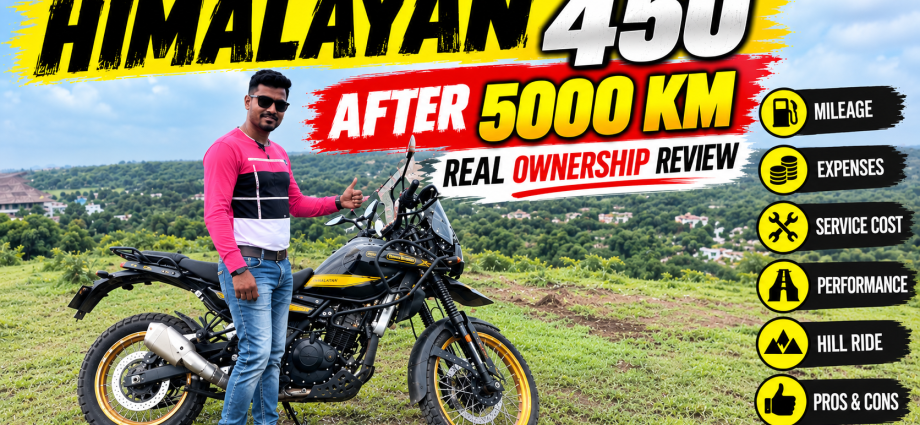
Enough distance to move beyond the excitement of a new motorcycle and start understanding what it is really like to live with the Royal Enfield Himalayan 450.
After riding the Himalayan 450 for 5,000 km, I wanted to share my honest ownership experience — including comfort, performance, mileage, highway riding, hill riding, maintenance, practical ownership costs and the things I like and dislike about the motorcycle.
This is not a first-day review. It is based on actual ownership and riding experience.
 Himalayan 450 After 5,000 KM
The Himalayan 450 is designed as an adventure motorcycle, and after 5,000 km, that character becomes much clearer.
My riding has included a combination of:
- City riding
- Highway rides
- Hill roads
- Long-distance trips
- Rough and uneven roads
- Monsoon conditions
- Everyday commuting
The biggest thing I noticed is that the Himalayan 450 feels most natural when the road becomes less predictable.
Whether it’s a winding mountain road, broken patch, gravel section or a long highway stretch, the motorcycle feels built for exploration rather than simply commuting from point A to B.
My Himalayan 450 Ownership Experience
Before buying the Himalayan 450, I had several questions:
How comfortable is it on long rides?
What mileage can I actually expect?
How much does ownership cost?
Is it practical for everyday use?
How does it perform on hill roads?
After 5,000 km, I have a much better idea of the answers.
 Engine & Performance
The Himalayan 450’s engine is one of the biggest reasons I enjoy riding the motorcycle.
The power delivery feels strong enough for highway touring while remaining manageable on technical roads.
For normal riding, the engine doesn’t require constant high-rev acceleration. On open roads, it has enough performance for confident overtaking and maintaining highway speeds.
On hill roads, the engine characteristics become even more enjoyable.
You can focus more on the road and less on constantly searching for the perfect gear.
My experience after 5,000 km
City: Comfortable and manageable for an adventure motorcycle.
Highway: Plenty of performance for touring.
Hills: Strong and enjoyable, particularly on winding roads.
Rough roads: This is where the Himalayan character really starts to make sense.
 Himalayan 450 Hill Riding
One of my favourite things about the Himalayan 450 is riding through the hills.
Mountain roads require a motorcycle that feels predictable when:
- Roads become narrow
- Surfaces become uneven
- Corners become sharper
- Elevation changes frequently
- The road suddenly turns into gravel or broken tarmac
The Himalayan 450 gives me the confidence to keep exploring.
And that is probably the biggest reason I enjoy taking it on weekend adventures.
 Highway Performance
For long highway rides, rider comfort becomes extremely important.
The Himalayan 450 offers a riding position that works well for touring, especially compared with motorcycles designed primarily for aggressive street riding.
During longer rides, I appreciate:
- Upright riding position
- Adventure-oriented ergonomics
- Good visibility
- Stable highway behaviour
- Strong enough performance for touring
However, wind protection and comfort will still depend on your height, riding position and accessories.
 Real-World Mileage
Mileage is one of the most common questions from potential buyers.
Your actual mileage will depend on:
Traffic + riding style + speed + road conditions + load + tyre pressure + luggage.
For my ownership experience, I track mileage based on actual fuel usage rather than relying only on the motorcycle’s display.
My Himalayan 450 mileage
| Riding condition | Approx. mileage |
|---|---|
| City riding | 30 km/l |
| Highway riding | 34 km/l |
| Hill riding | 32 km/l |
| Mixed riding | 30 km/l |
My overall real-world average after 5,000 km: [XX] km/l
Replace the figures above with your actual fuel-log numbers for maximum credibility.
 Himalayan 450 Ownership Expenses After 5,000 KM
One of the main reasons I wanted to write this article was to show that buying a motorcycle is only the beginning.
There are several ongoing costs:
- Fuel
- Service
- Engine oil
- Consumables
- Chain maintenance
- Accessories
- Insurance
- Cleaning
- Other small maintenance expenses
For example, if you travelled 5,000 km, achieved an average of 30 km/l, and paid approximately ₹100/litre:
5,000 ÷ 30 = 166.67 litres
166.67 × ₹100 = approximately ₹16,667
Your actual fuel expense will naturally vary depending on your average mileage and fuel price.
 Service & Maintenance
After 5,000 km, routine maintenance is an important part of ownership.
I recommend keeping a simple record of:
Service date | Odometer reading | Oil change | Chain cleaning/lubrication | Brake inspection | Tyre condition | Air filter | Battery
Any parts replaced
Keeping these records makes it much easier to understand the motorcycle’s real ownership cost over time.
 What I Like About the Himalayan 450
After 5,000 km, these are the things that stand out to me the most.
1. Adventure-ready character
It feels designed for riders who want to explore roads beyond the city.
2. Hill-road confidence
This is one of my favourite aspects of the motorcycle.
3. Touring comfort
The upright riding position works well for long-distance travel.
4. Versatility
One motorcycle can handle commuting, highways, weekend trips and mountain roads.
5. Riding experience
Perhaps the most important point: it makes me want to ride more.
And for an adventure motorcycle, that’s a big part of the ownership experience.
 Things I Don’t Like
No motorcycle is perfect.
After 5,000 km, I also have things I would like to see improved.
Weight
The motorcycle can feel heavy, particularly during slow-speed manoeuvres or while moving it around when parked.
City traffic
In heavy stop-and-go traffic, an adventure motorcycle isn’t always as effortless as a smaller commuter.
Running costs
Fuel and regular maintenance add up over time, especially when you ride frequently.
Accessories
Adventure riding can quickly become expensive once you start adding luggage, protection, touring accessories and other upgrades.
 Accessories I Use / Recommend
One of the interesting parts of owning an adventure motorcycle is setting it up for your riding style.
Depending on your requirements, useful touring equipment can include:
- Crash protection
- Hand guards
- Luggage
- Tank bag
- Phone/navigation mount
- Puncture repair kit
- Auxiliary charging solution
- Riding lights where legally appropriate
- Touring seat/accessories as needed
The best accessories are the ones that solve an actual problem you encounter while riding.
 Watch My Himalayan 450 5,000 KM Ownership Review
I have also created a video covering my Himalayan 450 ownership experience.
Himalayan 450 After 5,000 KM – Ownership Review
Is the Himalayan 450 Worth It for Long-Distance Touring?
After 5,000 km, my experience has shown me that the Himalayan 450 works particularly well for riders who enjoy exploration, touring and mountain roads.
It isn’t simply about getting from one destination to another.
For me, the biggest attraction is the ability to look at an unknown road and think:
“Let’s see where this goes.”
That’s what makes adventure riding special.
Final Thoughts After 5,000 KM
5,000 km is still only the beginning of a motorcycle’s life, but it is enough to understand much more than you can during a showroom test ride.
The Himalayan 450 has become more than just a motorcycle for me.
It’s my partner for:
Weekend escapes.
Mountain roads.
Long highway journeys.
Monsoon adventures.
Unexpected roads.
And there are many more kilometres still to come.
Next milestone: 10,000 KM.
Follow TeQrider for more Himalayan 450 ownership updates, motorcycle travel stories, maintenance experiences and riding adventures.